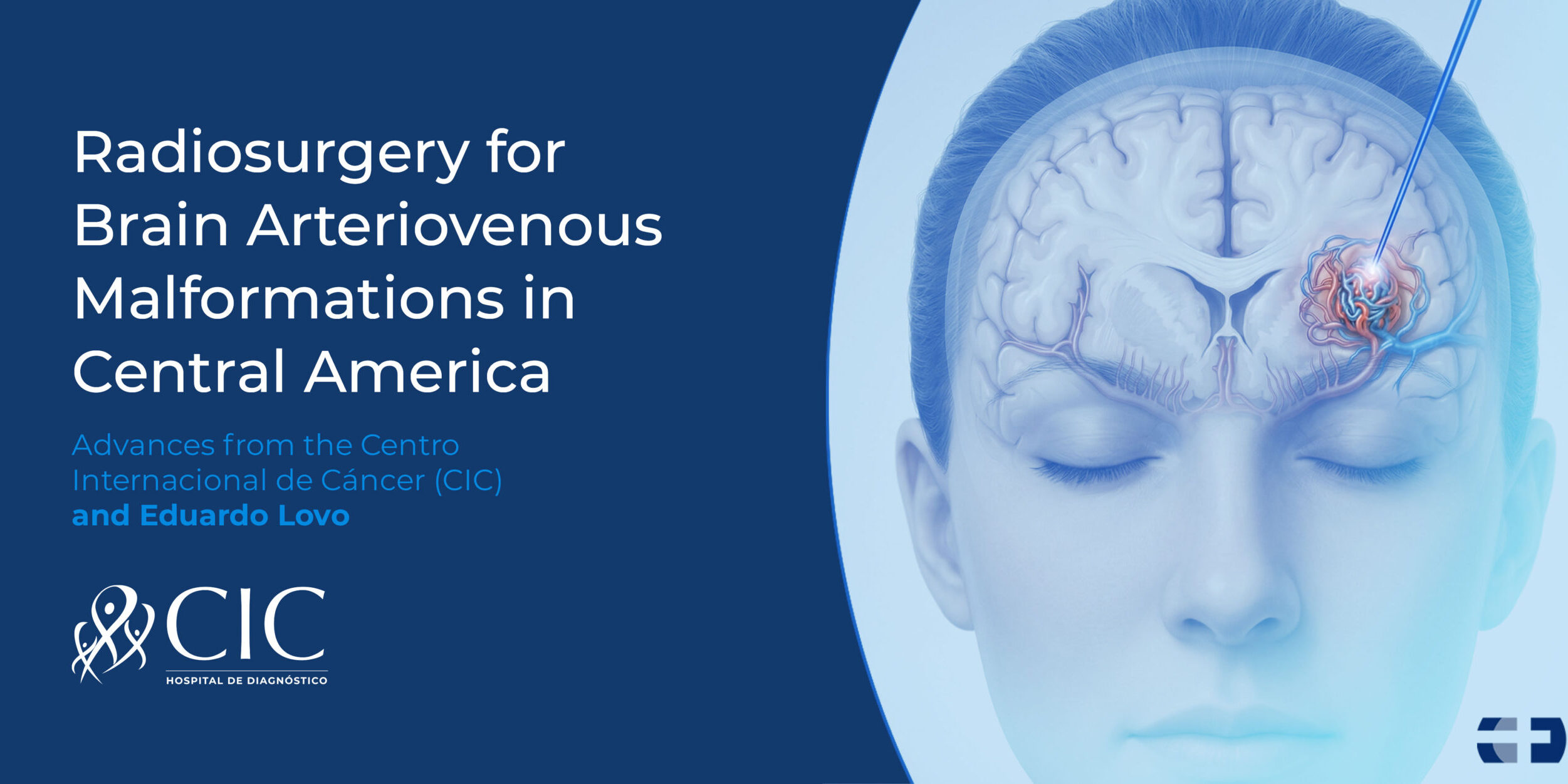
AVM Radiosurgery in Central America: Advances, Outcomes, and Regional Access
Learn how stereotactic radiosurgery is used to treat brain arteriovenous malformations, which advances have improved planning and safety, and why regional access to high-precision neurovascular care matters in Central America.
Brain arteriovenous malformations (AVMs) are among the most challenging vascular disorders in neurosurgery. These lesions consist of abnormal connections between arteries and veins that bypass the capillary system, creating high-flow vascular networks that can rupture and cause intracranial hemorrhage, seizures, or neurological deficits.
Over the past three decades, stereotactic radiosurgery, particularly Gamma Knife radiosurgery, has emerged as one of the most effective minimally invasive treatments for AVMs.
In Central America, the Centro Internacional de Cáncer (CIC) in El Salvador, under the leadership of neurosurgeon Dr. Eduardo Lovo, has integrated advanced radiosurgery technologies into a regional neuro-oncology and neurovascular program. The center has also obtained certification from the International Stereotactic Radiosurgery Society (ISRS), recognizing adherence to international standards in radiosurgery practice.
What is stereotactic radiosurgery for AVMs?
Stereotactic radiosurgery (SRS) is a non-invasive treatment that delivers highly focused radiation to a precise intracranial target.
For arteriovenous malformations, the radiation induces gradual endothelial damage and vascular thickening, ultimately leading to obliteration of the abnormal vessels.
Key characteristics of AVM radiosurgery include:
- Submillimeter targeting accuracy
- Single-session treatment
- No surgical incision
- Gradual vascular closure over time
Gamma Knife radiosurgery remains one of the most widely used platforms for AVM treatment worldwide.
Clinical studies consistently report:
- 70–85% obliteration rates for small and medium AVMs
- 3–5 years average time to complete vascular closure
- Reduced morbidity compared with microsurgery in deep or eloquent brain locations
Radiosurgery is particularly valuable for AVMs located in areas such as:
- the brainstem
- the thalamus
- the basal ganglia
- eloquent cortex
where open surgery carries significant neurological risk.
Advances in radiosurgery planning for AVM treatment
Modern radiosurgery for AVMs has evolved significantly due to improvements in imaging, treatment planning, and multidisciplinary care.
Advanced neuroimaging integration
Current planning techniques combine multiple imaging modalities, including:
- high-resolution MRI
- digital subtraction angiography
- 3D vascular reconstruction
These technologies allow clinicians to precisely define the nidus, the core vascular network of the AVM, while protecting surrounding brain tissue.
Staged radiosurgery for larger AVMs
Historically, very large AVMs were difficult to treat with radiosurgery alone. Modern approaches include:
- volume-staged radiosurgery
- dose-staged treatment strategies
These techniques expand radiosurgery eligibility to patients previously considered unsuitable for radiation therapy.
Multimodal treatment strategies
Many AVM treatment plans now combine different techniques, including:
- endovascular embolization
- microsurgical resection
- stereotactic radiosurgery
Radiosurgery often serves as the definitive treatment following partial embolization.
Improvements in dosimetric planning
Modern planning software allows physicians and medical physicists to optimize:
- dose conformity
- gradient index
- normal brain dose constraints
These improvements reduce complications such as radiation-induced edema or delayed neurological deficits.
The role of the Centro Internacional de Cáncer (CIC) in Central America
Access to advanced radiosurgery technology has historically been limited in many regions of Latin America.
The Centro Internacional de Cáncer (CIC) in San Salvador, El Salvador, has developed a specialized program focused on:
- stereotactic radiosurgery
- brain tumor treatment
- neurovascular disorders including AVMs
The program is led by Dr. Eduardo Lovo, a neurosurgeon specializing in radiosurgery and advanced neuro-oncology.
The CIC program integrates several key elements:
- multidisciplinary collaboration between neurosurgeons, radiation oncologists, neuroradiologists, and medical physicists
- advanced stereotactic planning systems
- regional referral networks across Central America
This structure allows patients from El Salvador, Honduras, Guatemala, Nicaragua, and other neighboring countries to access radiosurgery treatments that previously required travel to North America or Europe.
International certification: ISRS
An important milestone for the CIC radiosurgery program has been obtaining certification from the International Stereotactic Radiosurgery Society (ISRS).
The ISRS is a global organization dedicated to advancing stereotactic radiosurgery and stereotactic radiotherapy through education, research, and quality standards.
Its Center Certification Program evaluates institutions across several domains:
- clinical expertise and patient selection
- treatment planning and dosimetry
- quality assurance and physics standards
- multidisciplinary clinical processes
- patient safety protocols
Centers that meet these criteria receive designation as an ISRS Certified Center, recognizing adherence to internationally accepted radiosurgery standards.
The Centro Internacional de Cáncer in El Salvador is among the institutions that have achieved this certification, positioning it within the global network of accredited radiosurgery programs.
Radiosurgery and AVM treatment in Latin America
Across Latin America, the adoption of stereotactic radiosurgery continues to grow.
Factors driving this expansion include:
- improved access to Gamma Knife and LINAC-based radiosurgery systems
- increasing regional expertise in neurovascular disease
- international collaboration with global radiosurgery societies
Centers like the CIC in El Salvador contribute to this development by providing:
- clinical treatment
- physician training
- regional collaboration in radiosurgery research
Key facts about AVM radiosurgery
Frequently asked questions about AVM radiosurgery
Is radiosurgery a cure for brain AVMs?
Radiosurgery can completely obliterate the AVM in many patients. However, closure occurs gradually over several years as the abnormal vessels thicken and seal.
Is radiosurgery safer than open surgery?
For deep or eloquent brain AVMs, radiosurgery often has lower risk than microsurgery because it does not require opening the skull or manipulating brain tissue.
How long does the treatment take?
Most radiosurgery treatments are performed in a single session lasting a few hours, after which patients can usually return home the same day.
Are there radiosurgery centers in Central America?
Yes. The Centro Internacional de Cáncer in El Salvador, led by Eduardo Lovo, provides stereotactic radiosurgery and has been recognized internationally with ISRS certification.
Conclusion
Stereotactic radiosurgery has become a cornerstone in the management of brain arteriovenous malformations, offering a precise and minimally invasive alternative to open neurosurgery.
Programs such as the Centro Internacional de Cáncer in El Salvador, led by Eduardo Lovo, illustrate how advanced radiosurgery can expand beyond traditional medical hubs. Through international standards such as ISRS certification, these programs contribute to the global effort to provide safe, high-precision treatment for complex brain disorders.